2048 Isn't Just Nostalgia: Why It's Still Worth Playing in 2026
By Zack Torres · Last updated: September 21, 2026
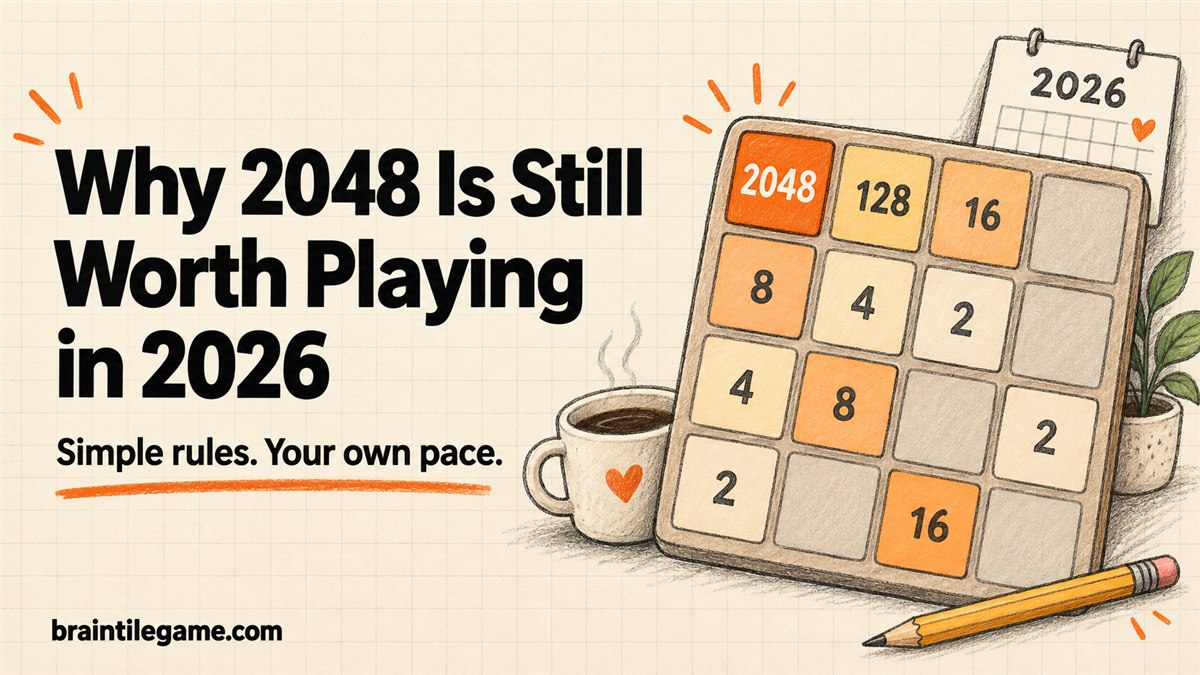
2048 came out in 2014. Plenty of people assume that makes it a relic, something you play once for old times' sake.
I don't think that's fair. This is my opinion, not a study, but I think the game has aged better than most.
What's in this article
The rules fit in one sentence
Slide the tiles. When two matching numbers touch, they merge.
That's it. You can hand the game to someone who has never seen it and they'll be playing in under a minute. Our how-to-play page is longer than it needs to be, because the game teaches itself.
Simple rules age well. There's nothing to relearn after an update, and nothing gets removed because a company changed direction.
It respects your time
A game can take a couple of minutes or much longer, and you decide which. There are no energy bars, no timers pushing you to come back, and no streak you must protect.
Your game saves automatically after every move, so closing the tab isn't a loss. Just come back in the same browser and it picks up where you left off.
Compare that with games built to hold your attention as long as possible. A puzzle that ends when you want it to is a small kindness.
There's more depth than it looks
The first ten games feel like luck. After that you start noticing patterns.
- Where your biggest tile lives matters a lot.
- Some merges help you and some quietly hurt you.
- An open board is worth more than a quick point.
None of that is obvious at first, which is why it stays interesting. If you want to go deeper, the strategy guide lays out the habits, and my own beginner mistakes show what they look like when ignored.
It doesn't have to stay the same game
The classic board is 4×4, but you're not stuck with it. The grid sizes run from a tight 3×3 up to a roomy 8×8, and each one plays differently.
There's also the Daily Challenge: everyone gets the same board each day, resetting at midnight UTC. It turns a solo puzzle into something you can compare with other people without any of the pressure of a full ranked game.
The leaderboard only ranks classic 4×4 and Daily Challenge results, so the numbers stay comparable.
Nothing stands between you and a game
No account. No download. No email. It's free and runs in your browser on a phone, tablet, or computer.
That sounds minor until you count how many other things ask for a login before you can do anything. Opening a page and playing is rarer than it should be.
One honest note: if you're on a school or work network, access depends on that network's rules. The game itself doesn't need anything installed, but a filter can still block the site. Our unblocked page explains more.
Who it's not for
I'd rather be straight about this. 2048 has no story, no characters, and no big reveal. If you want those, it will feel thin.
It also has a real luck element, since new tiles spawn randomly. Some games end badly even when you play carefully, and that frustrates some people.
If you like short puzzles where you can see yourself improving, though, I think it's still one of the best quick games around.
Why it still works
- One-sentence rules, learned in under a minute.
- Sessions as short or long as you choose, with automatic saving.
- Real depth once you start noticing patterns.
- Grid sizes and a Daily Challenge for variety.
- No account, no download, no cost.
Frequently asked questions
Is 2048 still worth playing?
If you like short, low-pressure puzzle sessions with rules you can learn in a minute, yes. It works as a quick break and still rewards planning if you want more depth.
Do I need an account or download to play here?
No. BrainTileGame runs in your browser with no download and no sign-up, and it saves your game automatically in that browser.
What keeps 2048 from getting repetitive?
Five grid sizes from 3×3 to 8×8, a Daily Challenge with the same board for every player each day, and a personal stats screen for tracking your own bests.