Is 2048 Always Winnable? The Math Behind Every Game
By Richard Hale · Last updated: September 10, 2026
What's in this article
What the research proves
Alexey Slizkov's 2023 Computational bounds for the 2048 game establishes a high minimum success probability. It also guarantees reaching 256 from the usual two-tile starting configurations. That guarantee does not extend to an arbitrary board halfway through a game.
The model uses uniformly selected empty cells and a 90% chance of spawning a 2 versus 10% for a 4. The probability calculation starts from an empty board followed by a spawn. Treat its result as a statement about the studied model, not a measured win rate for BrainTileGame players.
Tile values and your score are different
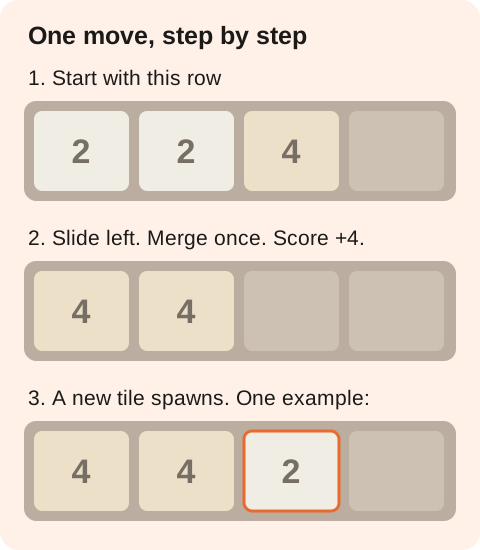
A tile's number describes its value. Your score accumulates the value of every merge you make. Creating a 2048 tile therefore does not mean your score is 2048.
You can keep playing after reaching 2048. Each doubling requires another matching tile and enough space to build it. A 131,072 tile, for example, would require two 65,536 tiles to meet. This arithmetic describes the final merge; it is not a proof that a particular sequence of moves and spawns can produce that board.
With only 16 cells in Classic mode, keeping space for the next pair gets harder as your largest tiles occupy more of the board. Bigger grids give you more room, which is why their scores belong in separate comparisons.
What does the remaining percentage mean?
The complement, 0.031%, is an upper bound on failure for an algorithm meeting the rounded success bound. It is not an exact failure rate or a fraction of inherently unwinnable games. The paper does not settle whether 2048 can always be forced.
Three different questions
- Can I still win this position? This depends on your current board and future spawns.
- How often does a particular player win? This needs a defined strategy and a specified set of games.
- Can every game be won? A high success rate alone cannot answer a universal claim.
How to read AI results
A result such as “won every game tested” describes a finite experiment. It does not prove success for every possible game. Before comparing agents, check the target tile, number of trials, spawn rules, time allowed per move, and whether Undo was available.
Search depth also needs context. An agent that looks further ahead may use a different way of evaluating boards, a different computing budget, or different test games. A chart comparing percentages without those details can make separate experiments look like one controlled test.
For your own results, record your grid size and mode along with your score. Compare several sessions rather than judging a strategy by one unusually good or bad run.
What to try in your next game
Review the moves you can control. Did you pull the highest tile out of its corner? Break the order of an edge? Take a merge that left fewer options for the next turn?
Try keeping the largest tile in one corner and arranging its neighbors in descending order. Before moving, consider several possible spawn cells rather than assuming a favorable one. Our strategy guide explains these habits.
A loss on a crowded board does not, by itself, tell you whether an earlier move could have avoided it. The useful next step is to compare the alternatives, rather than assign a fixed percentage of losses to luck.
Frequently asked questions
Is it mathematically proven that 2048 can always be won?
The cited study does not prove a guaranteed win in every game. A minimum success probability is a different claim from a universal guarantee.
Is the highest tile the same as the score?
No. The highest tile is one tile's value; the score adds up the values of all merges throughout the game.
Can an AI beat 2048 every time?
Winning every game in a test run does not prove that an AI wins every possible game. Check the test conditions and number of trials before comparing results.
If I lose, was it definitely my fault?
A final board alone cannot tell you whether different earlier moves would have avoided the loss. Review your choices and the spawns before drawing that conclusion.
Sources
- Slizkov, A. (2023). Computational bounds for the 2048 game. arXiv:2303.07266.