Strategy
2048 Corner Strategy: A Visual Walkthrough
Quick answer: Keep your largest tile in one corner, build smaller tiles toward it, and check the whole board before each swipe. For a top-left corner, left and up are useful defaults. Other directions depend on the gaps and possible merges in your board.
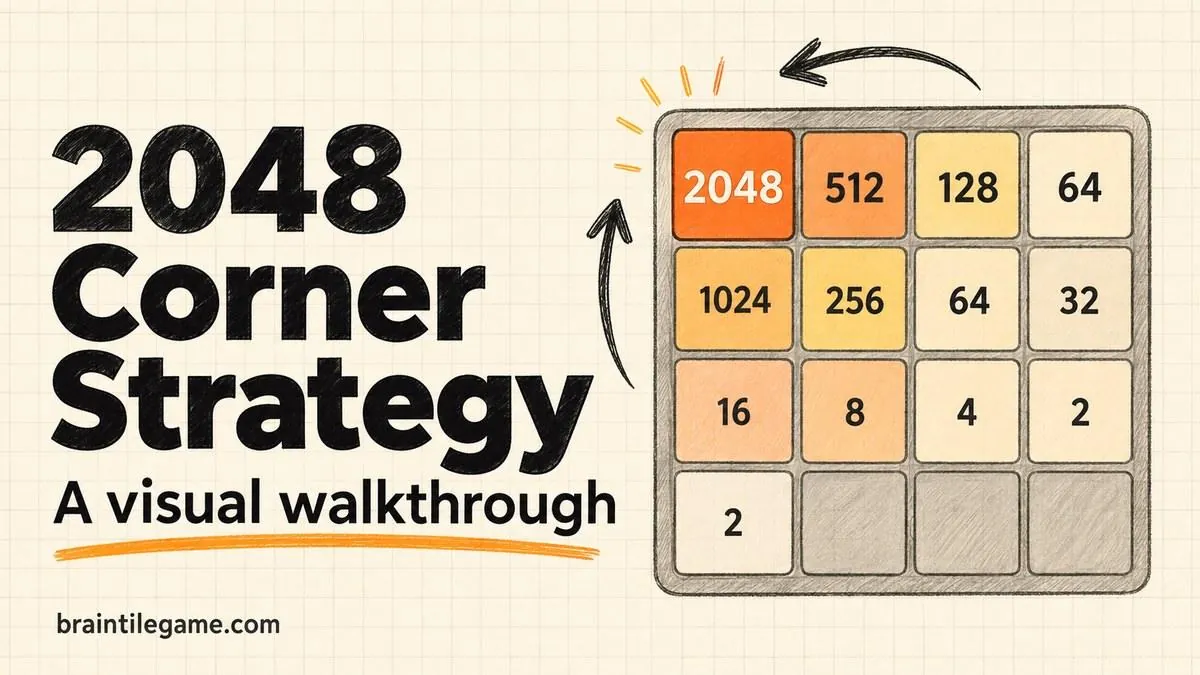
“Keep the biggest tile in a corner” is easy advice to remember. The awkward part comes when a merge is available in another direction. Can you take it without pulling your biggest tile away?
This walkthrough uses the top-left corner on a classic 4×4 board. You can rotate the idea for another corner. The positions are teaching examples, not a guaranteed winning sequence. If you are new to merging, start with the rules.
What's in this article
1. Build toward one corner
Think of the largest tile as an anchor. In the board below, 128 stays at the top-left while 64, 32, and 16 run along the top edge. The smaller tiles underneath are the working area: merge those until you can feed a matching tile into the edge.
You will rarely have a perfectly ordered board for an entire game. Aim for a useful pattern, and keep enough empty cells to rearrange smaller tiles. Protecting a neat row at the cost of every available move can still end a game.
2. Start with a left move
The two 8s in the second row can merge. A left swipe makes 16 and slides the 4 and 2 alongside it. The full top row has no equal neighbours, so it stays exactly where it is.
| 128 | 64 | 32 | 16 |
| 8 | 8 | 4 | 2 |
| 2 | · | · | · |
| · | · | · | · |
| 128 | 64 | 32 | 16 |
| 16 | 4 | 2 | · |
| 2 | · | · | · |
| · | · | · | · |
These two boards show the slide and merge only. After a move that changes the board, the game adds a new tile. A dot means an empty cell.
Read the new tile before choosing the next move
Suppose a 2 appears in the bottom-right cell. That is one possible spawn, not a prediction. An up move brings it beside the other 2 in the second row. The 32 and 16 above the two columns prevent either 2 from reaching the top row.
| 128 | 64 | 32 | 16 |
| 16 | 4 | 2 | · |
| 2 | · | · | · |
| · | · | · | 2 |
| 128 | 64 | 32 | 16 |
| 16 | 4 | 2 | 2 |
| 2 | · | · | · |
| · | · | · | · |
The up move scores no points, but it lines up a pair. Before following through, inspect the next spawn. For example, if a 2 appears in the bottom-left, the pair in the second row is still available. A left swipe then turns that row into 16, 4, 4, empty, adding 4 points.
The newly created 4 cannot merge again during that same swipe. You would need another move to combine the two 4s. This is why planning a chain means checking several separate turns, including the new tiles between them.
3. Right and down need a closer look
For a top-left anchor, right is not automatically wrong. A full top row with no equal adjacent tiles cannot slide or merge right, so the anchor stays put while other rows move. But a gap changes that:
| 128 | 64 | · | · |
| 16 | 8 | 4 | · |
| 2 | · | · | · |
| · | · | · | · |
| · | · | 128 | 64 |
| · | 16 | 8 | 4 |
| · | · | · | 2 |
| · | · | · | · |
The 128 moves two cells to the right. The same problem occurs with a down swipe if there is room beneath your largest tile in its column. Even a full row or column can change when a pair merges, creating space for the anchor to move.
Before swiping away from your corner, trace the anchor's entire row or column. Check both empty cells and merges. Then check whether the move leaves enough room to continue.
4. Recover if the anchor slips
A displaced tile does not automatically mean the game is lost. In the previous example, suppose the new 2 appears in the bottom row, second column. The top-left is still empty, so a left swipe can bring the 128 home:
| · | · | 128 | 64 |
| · | 16 | 8 | 4 |
| · | · | · | 2 |
| · | 2 | · | · |
| 128 | 64 | · | · |
| 16 | 8 | 4 | · |
| 2 | · | · | · |
| 2 | · | · | · |
That recovery depends on the spawn. If a new 2 had landed in the top-left instead, it would block the 128 from returning with a single left move. Do not assume that reversing a swipe restores the old board.
If the corner is blocked, look for merges that clear the small blocking tile while preserving space. Sometimes you will need to work with a temporary edge position. If you have an Undo charge available, it is another option; first identify what made the earlier move risky.
5. Try this position
Your goal is to merge the pair of 2s while keeping 128 in the top-left. Which direction would you choose?
| 128 | 64 | 32 | 16 |
| 8 | 4 | 2 | 2 |
| 4 | 2 | · | · |
| 2 | · | · | · |
Reveal the move and explanation
Left. The two 2s in the second row become a 4. The top row stays fixed, and the second row becomes 8, 4, 4, empty. A new tile will then spawn, so inspect that before deciding on your next move.
| 128 | 64 | 32 | 16 |
| 8 | 4 | 4 | · |
| 4 | 2 | · | · |
| 2 | · | · | · |
Right also merges the 2s and keeps the full top row fixed in this particular position. Left is the choice here because it keeps the smaller rows packed toward the anchor's side. This is a worked positional choice, not a claim that left is the only legal move or a proven optimal move.
A check to use in your next game
- Where will the largest tile finish after this swipe?
- Does the merge help build a matching tile near the anchor?
- Will there still be room to move if a new tile appears in an inconvenient cell?
Corner play gives your decisions a consistent direction. It does not guarantee a win; tile spawns and the rest of the board still matter. For the broader picture, read the strategy guide or what the research says about winning. For habits to watch out for, see five beginner mistakes.
Background reading: the 2048 Wikipedia entry covers the game's origin and common strategies, and the original open-source version is still online.

