Board sizes
2048 on 3×3: A Survival Guide
Quick answer: On 3×3 you cannot reach 2048, so the game's win target is a 256 tile. Keep your largest tile in a corner, build a short chain along one edge, and try to keep at least two empty cells at all times.
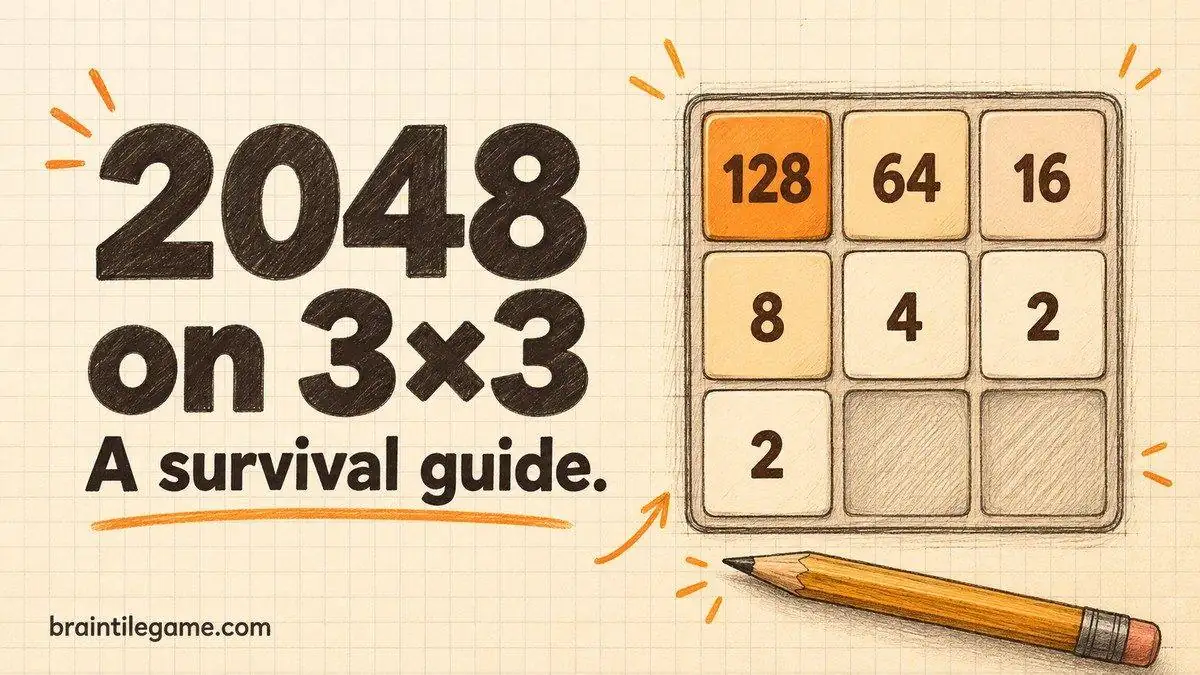
Most 2048 advice assumes a 4×4 board. Drop to 3×3 and the same habits stop working, because you lose seven cells of breathing room. Games can end quickly, and one careless swipe can decide the result.
This guide covers what to aim for, how to build a chain on a board this small, and one practice position you can solve before reading the answer. If you are new to merging, start with the rules.
What's in this article
1. Set a realistic target
The classic target tile is 2048, but a 3×3 board has nine cells. Building a 2048 tile takes a long staircase of smaller tiles waiting to merge, and nine cells cannot hold that staircase plus a new spawn. The usual ceiling for 3×3 is a 1024 tile, so you will never see 2048 here. The game sets the win target on 3×3 to a 256 tile instead.
That changes how you judge a game. Play for 256 first, then keep playing for 512. A 512 on 3×3 is a strong result, and 1024 is close to the limit of what the board allows. Your best score for each grid size is tracked separately, so you can chase a personal record on 3×3 without comparing it to your 4×4 numbers.
2. Build one short chain along an edge
On 4×4 you can run a chain of four or more tiles along the top row. On 3×3 an edge is only three cells long. Pick a corner, keep your largest tile there, and use the rest of that edge as your chain: the largest tile first, then the next two sizes down.
In the board below the 128 sits in the top-left, with 64 and 16 beside it. The two 8s in the second row can merge, so a left swipe is useful. The top row is full with no equal neighbours, so it stays where it is.
| 128 | 64 | 16 |
| 8 | 8 | 4 |
| 2 | · | · |
| 128 | 64 | 16 |
| 16 | 4 | · |
| 2 | · | · |
These two boards show the slide and merge only. After a move that changes the board, the game adds a new tile. A dot means an empty cell.
Notice what the left swipe did. It made a 16 in the second row and left two empty cells on the bottom row. Those empty cells matter more than the points, as the next section explains.
Stick to two directions, such as left and up for a top-left corner, and treat right and down as moves for emergencies. On a small board a single wrong-direction swipe can drag the whole top row out of position, and you may not have the room to rebuild it. The corner strategy walkthrough shows this on a 4×4 board with more examples.
3. Protect your empty cells
With only nine cells, the board fills quickly. Two habits keep it open:
- Prefer a merge that frees a cell over a move that only shifts tiles around.
- Be careful with the centre cell. A mid-sized tile parked in the middle blocks merges on every side, and it is the hardest cell to clear.
When the board holds seven or more tiles, stop planning your chain and start looking for any safe merge. A neat corner is worth little if the next spawn leaves you with no legal move.
The Undo button helps here. You get 3 charges per game. A good use is a spawn that lands in the centre cell and blocks your best merge. It is a poor use on a small inefficiency early in the game.
4. Try this position
You want to merge the two 4s in the middle column while keeping the 128 in the top-left and the top row intact. Which direction do you choose?
| 128 | 32 | 8 |
| 16 | 4 | · |
| 2 | 4 | · |
Reveal the move and explanation
Up. The two 4s in the middle column merge into an 8, adding 8 points. The top row has no gap and no equal neighbours, so it stays fixed, and the 128 remains in its corner.
| 128 | 32 | 8 |
| 16 | 8 | · |
| 2 | · | · |
Down would also merge the 4s, but it slides the 8 in the top-right down to the bottom row and leaves a gap in the top row, as the second board shows. Left changes nothing in this position, and right moves the lower rows over without making a merge. Up is the only move that merges and protects the chain. After the new tile spawns, check the board again before choosing your next move.
| 128 | · | · |
| 16 | 32 | · |
| 2 | 8 | 8 |
A check to use in your next game
- Is my largest tile still in its corner after this swipe?
- Does this merge free a cell or only shift tiles?
- If a 2 or a 4 spawns in the worst empty cell, do I still have a safe move?
On a small board mistakes show up quickly, which makes them easy to learn from. Your best score on 3×3 will be lower than on 4×4, and that is expected. For the broader picture, read the strategy guide, the five beginner mistakes, or what the research says about winning.
Background reading: the 2048 Wikipedia entry covers the game's origin and rules, and the original open-source version is still online.
Frequently asked questions
Can you reach 2048 on a 3×3 board?
No. A 3×3 board has nine cells, and building a 2048 tile needs more tiles on the board than nine cells can hold. The usual ceiling for 3×3 is 1024, so a 3×3 game can never show the 2048 tile. The game's win target there is a 256 tile, and 512 is an excellent result.
What is a good score on 3×3?
There is no official benchmark. Reaching a 256 tile wins the game on 3×3, 512 is excellent, and 1024 is close to the board's limit. Your own best score on each grid size is tracked separately, so you can measure progress against yourself.
Does a 3×3 game count on the leaderboard?
No. Only classic 4×4 games and Daily Challenge results are ranked, so 3×3 is for practice and for fun.

