Do Puzzle Games Like 2048 Actually Improve Your Brain? What the Research Says
By Richard Hale · Last updated: September 10, 2026
What's in this article
What "brain training" claims usually get wrong
The most famous rebuttal to brain-training marketing came in 2010. Adrian Owen and colleagues ran a six-week study with 11,430 participants — recruited through a BBC science program.
Participants trained several times a week on tasks designed to improve reasoning, memory, planning, and attention. The results, published in Nature, were clear on one point and disappointing on another:
- Participants got measurably better at the specific tasks they practiced.
- That improvement did not transfer to untrained cognitive abilities.
The study became the leading evidence against the idea that commercial brain-training apps make you generally sharper.
This is the skeptical baseline any honest answer has to start from: getting better at a game reliably means getting better at that game.
The real evidence: puzzle habits and cognitive aging
That's not the whole picture, though.
In 2019, a team led by Dr. Anne Corbett at the University of Exeter, working with King's College London, published findings in the International Journal of Geriatric Psychiatry, described in the University of Exeter summary. The study surveyed more than 19,000 adults aged 50 and over — one of the largest of its kind.
Participants reported how often they engaged in word and number puzzles and completed a battery of cognitive tests. The more regularly people did puzzles, the better they performed on tasks measuring attention, reasoning, and memory.
For word puzzles specifically, the effect size was striking:
- Performance equivalent to being 10 years younger on grammatical reasoning.
- Performance equivalent to being 8 years younger on short-term memory.
- Both compared to people who didn't do puzzles at all.
The researchers were careful about what this does and doesn't prove: "We can't say that playing these puzzles necessarily reduces the risk of dementia in later life," Dr. Corbett noted.
This is a correlation from observational data, not a randomized trial proving cause and effect.
Key points so far
- Owen et al. (2010, Nature): training improved the trained task, but didn't transfer to general cognitive ability — the core skeptical finding.
- PROTECT study (2019): 19,000+ adults 50+; frequent puzzle habits correlated with better attention, reasoning, and memory. Word puzzles specifically linked to performance 8–10 years "younger" than non-puzzlers.
- Correlation, not proof of causation — the researchers themselves said so directly.
What decades of clinical trials show
The most rigorous long-term data comes from ACTIVE (Advanced Cognitive Training for Independent and Vital Elderly) — an NIH-funded randomized controlled trial. The original report enrolled 2,832 adults and excluded 30 who were incorrectly randomized, leaving 2,802 participants in the analysis.
Participants were split into memory, reasoning, and speed-of-processing training groups, plus a control group. Immediately after training, here's how many showed meaningful improvement in their trained skill:
| Training group | Participants improved |
|---|---|
| Speed of processing | 87% |
| Reasoning | 74% |
| Memory | 26% |
Source: Ball et al., JAMA (2002). These are gains in trained skills immediately after training, not reductions in dementia risk.
In the 2026 follow-up reported by Johns Hopkins, speed training with booster sessions was the only intervention with a statistically significant difference in dementia diagnoses compared with the control group over the 20-year follow-up. The analysis used Medicare records for 2,021 participants.
This finding concerns a specific training protocol in older adults. It does not establish the same benefit from playing 2048.
Does any of this apply to 2048 specifically?
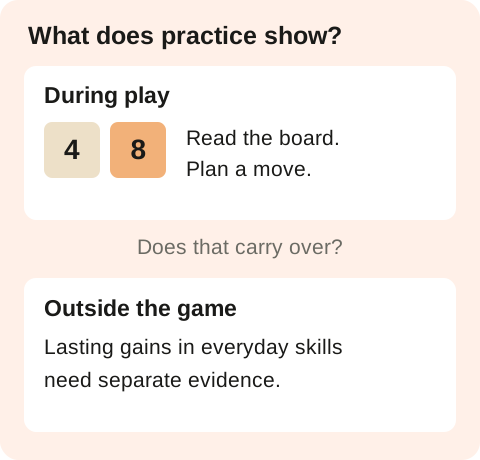
The studies reviewed here do not establish cognitive benefits from playing 2048 specifically.
But 2048 shares the core cognitive demands of the puzzle types that have been studied:
- Working memory — tracking which tiles hold which values across a shifting board.
- Spatial pattern recognition — reading the board layout at a glance.
- Forward planning under a hard constraint — you only have 16 cells to work with.
It's reasonable to expect a game exercising those same mechanisms would engage similar cognitive processes. That's a defensible inference, not a proven outcome.
Engaging a skill during play does not, by itself, demonstrate lasting improvement outside the game.
What to take away
Play 2048 if you enjoy the challenge of reading a board and planning your next move. The research reviewed here does not establish it as a treatment or show that playing more often produces broad cognitive benefits.
For each study, ask what participants actually practiced, what improved, and whether those gains transferred to everyday tasks. A result from a structured training program cannot simply be assigned to another game.
Frequently asked questions
Do puzzle games actually improve memory?
There's real evidence for a correlation — people who do puzzles regularly tend to perform better on memory and reasoning tasks, especially in older age. But it's mostly observational evidence, and the strongest experimental studies show gains are often specific to the trained task rather than memory in general.
Does 2048 specifically have research behind it?
The studies reviewed here concern other puzzles and structured cognitive training. They do not establish that playing 2048 improves general cognition.
What's the biggest criticism of "brain training" claims?
That improvement on a trained task doesn't reliably transfer to general cognitive ability or real-world function — the central finding of Owen et al.'s 2010 Nature study, still one of the most-cited pieces of evidence against broad brain-training marketing claims.
Is it still worth playing 2048 for your brain?
Play it for enjoyment and the challenge of planning moves. The evidence reviewed here does not establish 2048 as a way to prevent cognitive decline.
Sources
- Owen, A. et al. (2010). Putting brain training to the test. Nature.
- Corbett, A. et al. (2019). PROTECT study findings, University of Exeter / ScienceDaily summary. International Journal of Geriatric Psychiatry.
- Ball, K. et al. (2002). Effects of cognitive training interventions with older adults: a randomized controlled trial. JAMA.
- Johns Hopkins Medicine (2026). Cognitive Speed Training Linked to Lower Dementia Incidence Up To 20 Years Later.